Astra reads old handwriting, and it's a real leap
Last week OpenAI released a new model, Astra, and over the weekend I finally got my hands on it. Of course, the first thing I gave it was revision lists (the poll-tax censuses of the 18th–19th centuries) and parish registers of the Russian Empire (the books of births, marriages and deaths kept by Orthodox churches) :)
And it looks like we’ve got a real leap in quality here. I’m very, very happy with how it reads old handwriting now.
For the experiment, I opened Codex (OpenAI’s coding agent), added a folder of revision lists I had on my computer, and created an empty Google Sheet for the village. I asked it to transcribe all the revisions, keep their structure, and put each one on its own tab.
About an hour later the sheet was filled in. I double-checked it, fixed a couple of inaccuracies, and asked Codex to draft an article based on it for Rodnaya Vyatka, a local history website about the Vyatka region. Then I published it there myself (in Russian).
I could have stopped there, but I got curious about what else I could squeeze out of it. I asked it to build a GEDCOM file for the whole village from all the revision lists. And, while it was at it, to open my own family tree database and check: who haven’t I added yet? Where might I have made mistakes?
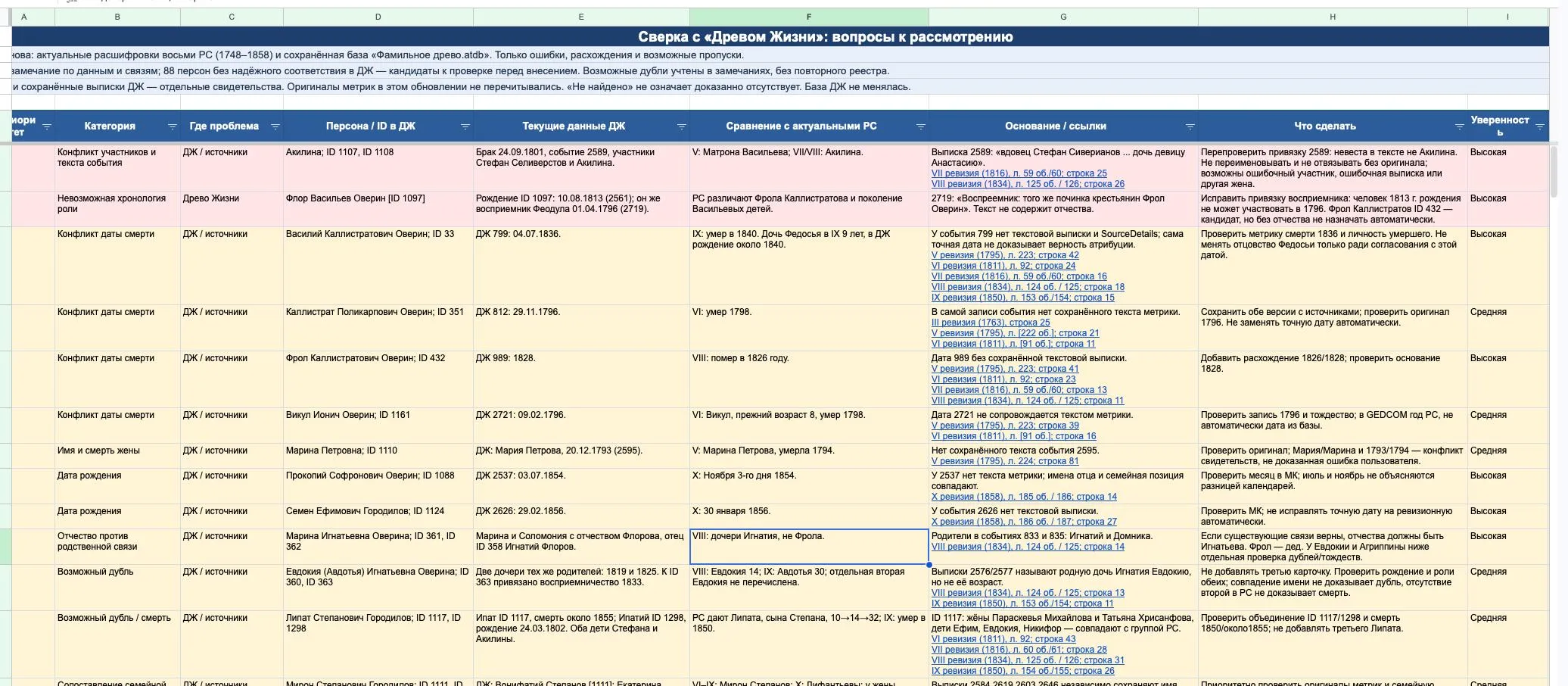
Codex buzzed away for another hour and came back with recommendations on what to fix and whom to add. From there, you can ask it to make the changes, or double-check everything yourself and move it into your tree by hand.
All in all, if you haven’t tried it yet, I highly recommend it. In my opinion, transcribing old parish registers, confession lists (annual parish lists of households recording who came to confession and communion) and revision lists can now be done almost automatically :)