Genealogists are no longer needed
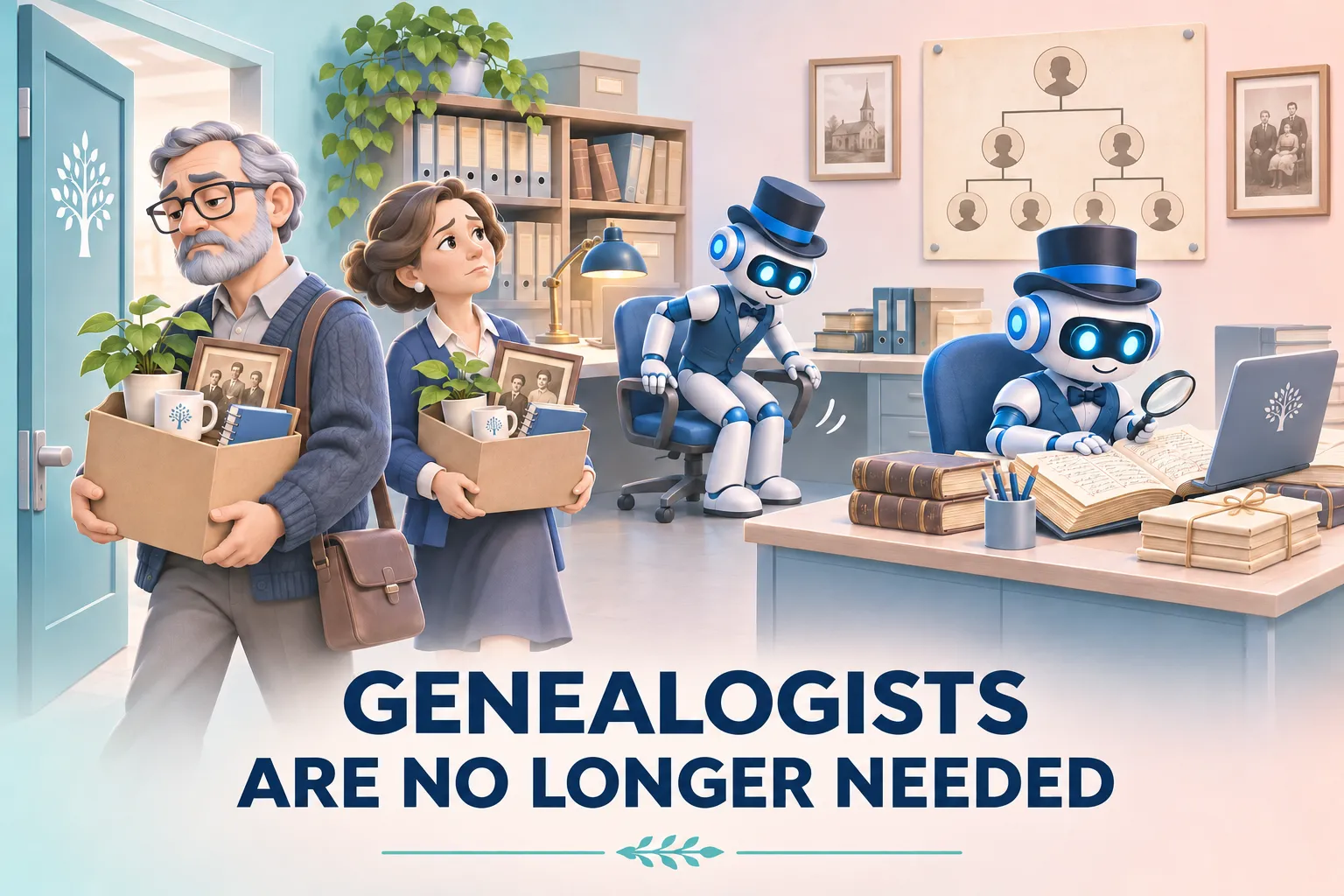
For several weeks, nearly every genealogy community I follow has been discussing Denis Shiryaev’s ex-ussr-kinship-research skill. It’s a set of instructions and tools for an AI agent that helps research family history.
I’ve tried it too: in skilled hands, it’s a very good tool. Dmitry Kudinov has already covered its features in a Russian-language review, so I won’t repeat that here. I’m more interested in those skilled hands, and in the future of the profession.
First, a detour into software development, where I work and where these changes are visible earlier. Over the past year, the job has changed dramatically:
- Almost nobody in my tech circle writes code by hand anymore. This isn’t just a quirk of my own circle. In April 2026, Google said that AI generates 75% of its new code, which engineers then review and approve. There are plenty of similar reports from other companies. The important part: programmers are no longer writing code themselves. The very thing they spent years learning and doing.
- As a result, many people in tech have lost their jobs and are struggling to find new ones: fewer programmers are needed just to write code. According to Indeed’s August 2026 data, software development job postings in the US were about a quarter below their February 2020 level. After years of growth, the market has stalled.
- In the new projects and companies I’ve seen over the past six months, teams are changing too. One product person working with AI agents can cover tasks that used to need several specialists. In my experience, that person needs a technical background: a former programmer with entrepreneurial instincts and a feel for products, for example.
The changes are uneven, and I feel we’re still only at the beginning.
What does this have to do with genealogy, and with that skill?
I see a similar shift in genealogy, just happening later. The work of a genealogist is still there, but what it involves is changing dramatically. New tools let fewer researchers get more work done, faster. We can take on investigations that used to demand too much time and manual work.
What has changed for me? Almost every part of the work:
- finding and working with sources, including material beyond Yandex’s digitized archive search and records that haven’t been digitized;
- building family trees and checking conclusions;
- developing research hypotheses;
- gathering information and conducting interviews;
- working with local history and biographies.
Genealogy has also grown from a hobby into a hobby with paid work on the side. I received a few commercial inquiries and decided to take them on: projects I simply wouldn’t have accepted before. The clients were very happy with the results. In my experience, these tools let me handle such projects faster and at a much lower cost than a large genealogy company would charge.
For example, to untangle one branch of a family of serfs with no surnames in Imperial Russia, we had to map the family relationships of an entire village over a century and a half. We indexed all the available parish registers of births, marriages and deaths, census records, confession registers listing parish households, and an estate charter. Along the way, we found and corrected numerous errors in an earlier investigation by a large company.
Back to the skill
What makes the skill at the start of this post worth all the attention? It creates an expectation: press a button, get your family tree. In practice, it’s more involved. Using it effectively takes both the ability to work with AI agents and knowledge of genealogy. I think that helps explain why reactions range from enthusiastic to sharply negative.
In skilled hands, it lets you see what your work will look like in the future, or perhaps already does today. Better still, you can borrow its ideas for your own tools and change the way you work, or simply the way you search for your ancestors.